
Hair Transplant After 60: Candidacy, Healing, and Expectations
Hair transplant after 60: candidacy, FUE vs FUT, recovery, realistic results, cost by stage, and how it compares to alternatives for older adults.
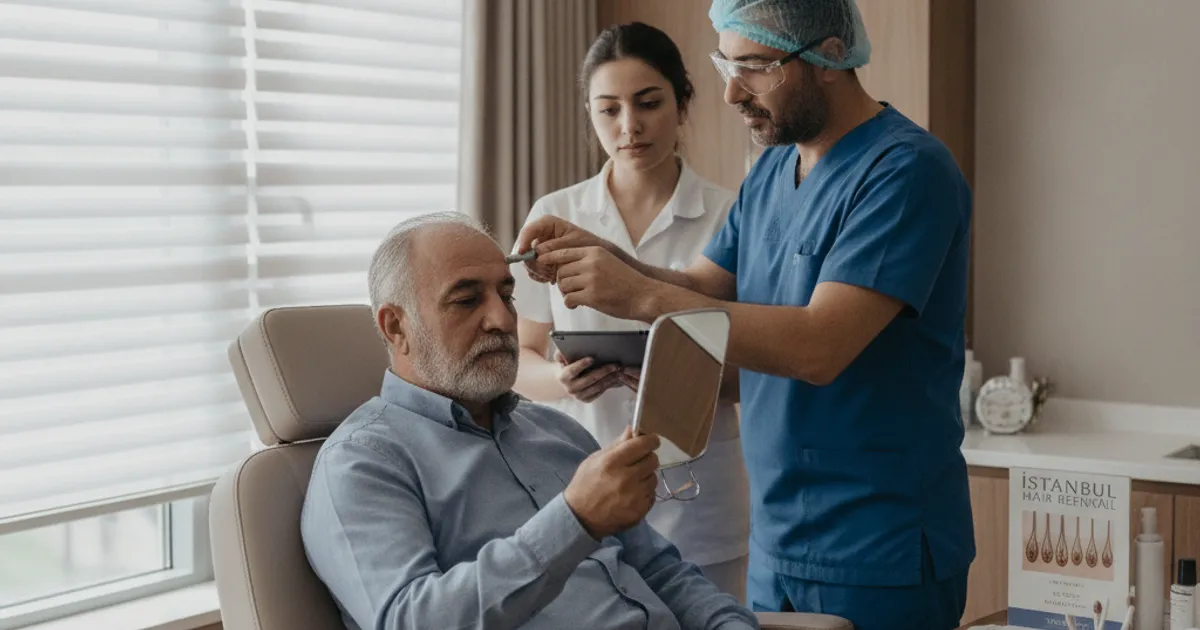
Hair Transplant After 60: An Overview
A hair transplant after 60 is the same basic procedure as it is at 30 or 40: hair follicles are taken from the back and sides of the scalp and moved to thinning or bald areas. What changes is the context. At 60-plus, surgeons think harder about donor hair quality, scalp laxity, overall health, and how much cosmetic benefit is realistic. The goal is not a teenage hairline. It is a natural-looking improvement that holds up over the next decade or two. Many men and women in their 60s are good candidates, but candidacy is more individualised than for younger patients.
Who Is a Candidate for Hair Transplant After 60?
Candidacy comes down to four things: how much donor hair you have, how stable your hair loss is, your general health, and what you expect. Surgeons typically assess donor density with a scalp exam and sometimes trichoscopy. They also ask about medications, blood pressure, diabetes, bleeding disorders, and smoking. If you are on blood thinners, that does not automatically rule you out, but it needs to be managed with your doctor. The best candidates are people whose hair loss has slowed or stabilised and who have realistic goals.
- Good donor hair density in the back and sides of the scalp
- Hair loss that has been stable for a year or more, ideally longer
- Controlled medical conditions such as hypertension or diabetes
- No active scalp infection or uncontrolled skin disease
- Realistic expectations about density and hairline placement
- Willingness to follow post-op instructions and attend follow-ups
How a Hair Transplant Is Performed (FUE and FUT)
There are two main techniques: follicular unit excision (FUE) and follicular unit transplantation (FUT). In FUE, individual follicular units are punched out from the donor area with a small circular tool and then implanted into recipient sites. In FUT, a strip of scalp is removed from the donor area, the strip is dissected into grafts under a microscope, and the wound is closed with stitches. Both are usually done under local anaesthesia, sometimes with light sedation. The procedure can take several hours depending on the number of grafts.
- FUE: no linear scar, faster superficial healing, but requires shaving the donor area and can be more expensive per graft
- FUT: allows a larger number of grafts in one session, leaves a linear scar, and may be better for patients with limited donor density
- Both techniques require careful graft handling and proper recipient site design
- Most sessions involve a few hundred to a few thousand grafts depending on the area treated
| Feature | FUE | FUT |
|---|---|---|
| Scarring | Small dot scars | Linear scar |
| Donor area shaving | Usually required | Not always required |
| Graft yield per session | Moderate to high | High |
| Recovery time | Faster surface healing | Slightly longer due to stitches |
| Best for | Short hairstyles, smaller sessions | Larger sessions, limited donor density |
Recovery and Healing After 60
Healing after 60 is broadly similar to healing at 40, but skin elasticity and circulation tend to be a bit slower. That can mean slightly more swelling or bruising, and it may take a little longer for the donor area to feel completely normal. The first week is the most active: scabs form, then flake off. Within a couple of weeks, most people look presentable. Shock loss, where some transplanted and native hairs shed, is common and temporary. New growth usually starts a few months in, with visible results by around six months and final density taking up to a year and a half.
- First few days: rest, avoid touching grafts, sleep with head elevated
- First week: gentle washing begins, scabs start to loosen
- First month: shock loss may occur, donor area sensitivity fades
- Months 3–6: new hair growth becomes visible
- Months 12–18: final results mature
Realistic Results and Expectations for Older Patients
The biggest difference for patients over 60 is expectation management. Younger patients often want a dense, low hairline. Older patients usually do better with a more conservative hairline and strategic coverage that accounts for future loss. Surgeons also consider that donor hair may thin with age, so they plan for long-term stability rather than maximum density today. Results can be very satisfying, but they are rarely "full head of hair" transformations. The aim is a natural, age-appropriate improvement.
- A conservative hairline often looks more natural on older faces
- Density may be lower than what a younger patient would achieve
- Donor hair quality and scalp laxity affect graft survival
- Results are permanent for the transplanted follicles, but native hair can continue to thin
- Some patients combine surgery with medication to protect non-transplanted hair
Cost of Hair Transplant After 60
Cost depends on the number of grafts, the technique, the clinic's location, and whether sedation or PRP is included. Pricing is usually quoted per graft or per session. The table below shows typical graft ranges by stage of hair loss. Because actual prices vary widely by clinic and region, we do not list specific dollar figures here. Your surgeon will provide a personalised quote after assessing your donor area and goals.
| Stage of Hair Loss | Typical Graft Range | Pricing Basis |
|---|---|---|
| Early | 1,000–1,500 | Per graft or per session; varies by clinic |
| Moderate | 1,500–2,500 | Per graft or per session; varies by clinic |
| Advanced | 2,500–4,000+ | Per graft or per session; varies by clinic |
Graft ranges are approximate and depend on the area treated, donor density, and the surgeon's plan. Always ask for a written quote that itemises grafts, technique, anaesthesia, and follow-up visits.
How Hair Transplant Compares to Alternatives for Older Adults
Surgery is not the only option. Medications like minoxidil and finasteride can slow loss and sometimes regrow hair, but they require ongoing use and may have side effects. Low-level laser therapy and PRP injections are less invasive but have modest evidence. Hairpieces and concealers are non-surgical and immediate but need maintenance. For many people over 60, the decision comes down to how much maintenance they want and how permanent they want the result to be.
| Option | Invasiveness | Permanence | Ongoing Cost | Best For |
|---|---|---|---|---|
| Hair transplant | Surgical | Permanent for transplanted hair | One-time plus possible touch-ups | Stable loss, good donor hair |
| Medication | Non-surgical | Temporary, requires continued use | Monthly | Early to moderate loss |
| PRP injections | Minimally invasive | Temporary | Per session | Adjunct to surgery or medication |
| Hairpiece | Non-surgical | Temporary | Regular replacement | Quick cosmetic fix |
- Surgery offers the most permanent result but requires candidacy and recovery time
- Medications are easy to start but need consistency and monitoring
- PRP and laser therapy work best as add-ons, not stand-alone solutions
- Hairpieces are immediate but require upkeep and replacement
Choosing a Clinic and Surgeon When You're Over 60
Experience matters, but so does honesty. Look for a surgeon who regularly treats older patients and who is willing to tell you if you are not a good candidate. Ask about their complication rates, how they handle medical comorbidities, and what their follow-up protocol looks like. Check that the clinic is properly licensed and that the surgeon performs the procedure themselves rather than delegating to technicians. Reading patient reviews and seeing before-and-after photos of patients in your age group can help set expectations.
- Confirm the surgeon's credentials and licensing
- Ask how many older patients they treat per year
- Request before-and-after photos of age-matched patients
- Discuss your medical history openly, including medications
- Clarify who performs each step of the procedure
- Ask about follow-up appointments and emergency contact
Frequently Asked Questions
Is 60 too old for a hair transplant?
No. Age alone is not a disqualifier. Surgeons assess donor hair, scalp health, medical history, and expectations. Many people in their 60s and even 70s are good candidates if their hair loss is stable and they are in reasonable health.
How long does recovery take after 60?
Most people can return to normal activities within a week, though strenuous exercise should wait a bit longer. Visible scabbing usually clears within a couple of weeks. New hair growth starts a few months in, with final results taking up to a year and a half. Healing may be slightly slower than for younger patients.
Will the results look natural on an older face?
Yes, if the surgeon designs a conservative hairline that suits your age and facial structure. Older patients often get better long-term results with a slightly higher, more natural hairline rather than an aggressive, low one.
Can I have a hair transplant if I take blood thinners?
Possibly, but it requires coordination with your prescribing doctor. Some surgeons will adjust the medication plan around surgery. Never stop blood thinners on your own without medical advice.
More Guides
- Hair Transplant for Men With Scalp Tattoos: What to Know
Scalp tattoos and hair transplants can coexist. Learn how ink affects surgery, recovery, results, candidacy, cost, and alternatives in this plain-English guide.
- No-Shave FUE Transplant: What It Is and Who It Suits
Learn how a no-shave FUE hair transplant works, who it suits, recovery, results, and cost. A clear, factual guide to this minimally shaven technique.
- Hair Transplant Revision: When to Fix and When to Wait
A practical guide to hair transplant revision surgery: why it's needed, when to fix vs. wait, how it's performed, recovery, costs, and alternatives.
- Hair Transplant for Fine Hair: Graft Selection & Density
Fine hair changes how a hair transplant is planned. Learn about graft selection, density limits, recovery, costs, and who suits this approach.