
Body Hair to Scalp Transplant: Grafts, Results, Limits
Body hair to scalp transplant explained: how BHT works, graft numbers, recovery, realistic density limits, and who it suits.
What Is a Body Hair to Scalp Transplant?
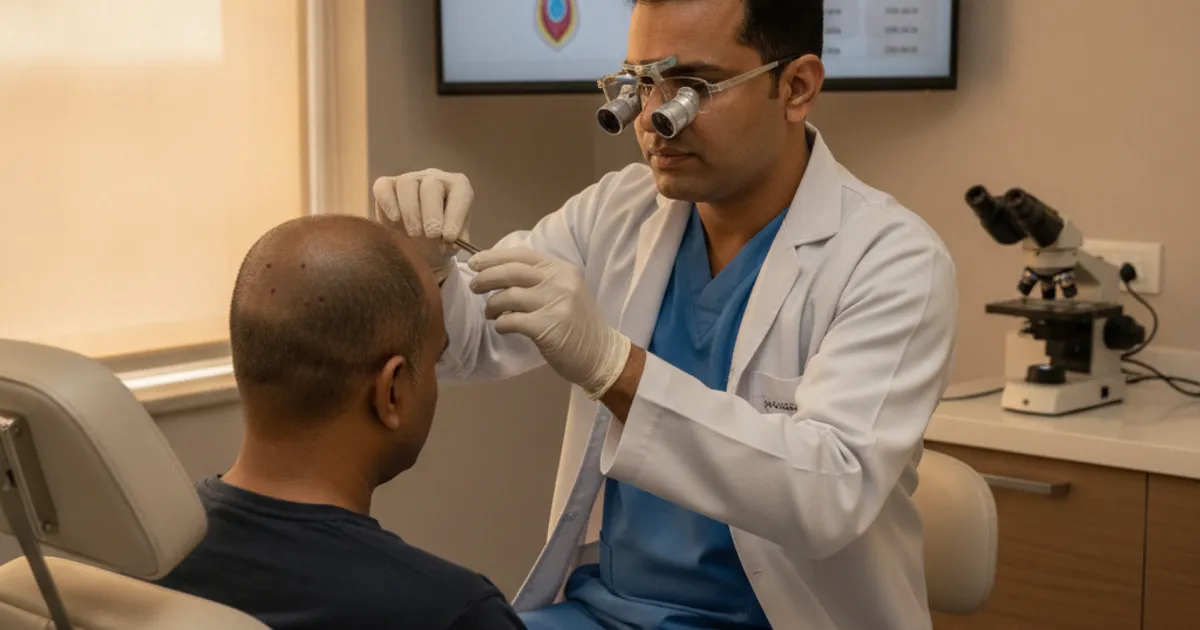
A body hair to scalp transplant — often shortened to BHT — is a hair restoration procedure where follicles are harvested from areas of the body other than the scalp and moved into thinning or balding zones on the head. The most common donor areas are the beard, chest, back, arms, and legs. It is not a different surgery in principle from a standard hair transplant; it is the same follicular unit extraction (FUE) technique applied to a wider donor pool. The reason it exists is simple: some people do not have enough dense scalp donor hair to cover the area they want to treat, and body hair gives surgeons another source of grafts.
The idea has been around for years, but it became more practical as FUE tools improved and surgeons got better at handling follicles from different parts of the body. Body hair follicles behave differently from scalp hair — they tend to be finer, grow at different angles, and have shorter growth cycles — so the technique is more about careful planning than simply moving more grafts.
- Donor sources: beard, chest, back, arms, legs, and sometimes pubic or axillary hair
- Harvest method: usually FUE, occasionally a mix of FUE and strip harvesting for scalp donor
- Typical use case: adding density or coverage when scalp donor supply is limited
- Not a replacement for a standard scalp transplant when good scalp donor hair is available
How Body Hair to Scalp Transplant Works: Step-by-Step
The procedure follows the same broad stages as any FUE transplant, but with extra attention to donor selection and graft handling. Body hair follicles are more fragile than scalp follicles, so the surgeon has to work carefully and not overload a single session.
Recovery After Body Hair to Scalp Transplant
Recovery from a body hair to scalp transplant is similar to a standard FUE recovery, with one extra consideration: you now have healing donor areas on your body as well as your scalp. Chest and beard donor sites can be sore, and beard extraction can leave small scabs that are visible for a week or two. Most people can return to desk work within a few days, but strenuous exercise and swimming should wait longer.
| Timeframe | What Usually Happens |
|---|---|
| First few days | Scalp and body donor areas are tender. Small scabs form. Sleep with your head elevated if advised. |
| First week to 10 days | Scabs begin to loosen. Gentle washing per clinic instructions. Swelling around the forehead usually settles. |
| First few weeks | Transplanted hairs shed — this is normal and expected. Donor areas on the body start to look less obvious. |
| First few months | Dormant phase. Little visible change. Some patients worry nothing is happening; this is the waiting period. |
| Months 4–8 | New growth becomes visible. Body-hair grafts often emerge finer and slower than scalp grafts. |
| Months 9–12 and beyond | Most of the result is visible. Density continues to improve slightly for some patients. |
- Avoid heavy lifting, gym work, and swimming for at least two weeks unless your surgeon says otherwise
- Beard donor areas can look patchy for a short period — most people find this temporary
- Sun exposure on both scalp and body donor sites should be limited in the first few weeks
- Follow the clinic's washing routine closely; it affects scab healing and graft survival
Results: Growth, Density, and Realistic Limits
This is where expectations matter most. Body hair to scalp transplant can produce a real improvement, but it rarely matches the density of a good scalp-donor transplant. Body hair follicles are typically finer, grow more slowly, and have a shorter anagen (growth) phase. That means the hairs may not grow as long, and they may look softer or wispier than the surrounding scalp hair. Used well, they can add coverage and help blend a thinning area. Used badly, they can look sparse and uneven.
- Body hair grafts generally survive at a lower rate than scalp grafts, so more grafts may be needed for the same visual effect
- Beard hair is often coarser than chest or leg hair, which can affect coverage
- Body hair is often best for adding density behind an existing hairline, not for creating a new hairline
- Results are gradual — plan on 12 months before judging the outcome
- A single session rarely transforms a large bald area; multiple sessions are common
Who Is a Good Candidate for Body Hair to Scalp Transplant?
The classic candidate is someone with limited scalp donor hair but reasonable body hair density. That includes people with advanced hair loss, people who have already had a scalp transplant and need more coverage, and people whose scalp donor area has been thinned by previous surgery or scarring. It can also help in cases of scarring alopecia or repair work where scalp donor is scarce. It is not usually the first choice for someone with plenty of healthy scalp donor hair.
- Good scalp donor supply? A standard scalp transplant is usually the better option
- Limited scalp donor but decent beard or chest hair? BHT may be worth discussing
- Active hair loss still progressing? Stabilise first, otherwise you are chasing a moving target
- Realistic expectations about density and texture are essential
- Body hair density varies a lot between individuals — the surgeon needs to assess it in person
| Candidate Profile | Suitability for BHT |
|---|---|
| Advanced baldness, weak scalp donor | Often suitable, usually as part of a combined plan |
| Previous scalp transplant needing more density | Often suitable |
| Scarring alopecia with limited scalp donor | Sometimes suitable, depends on scar tissue |
| Early hair loss with good scalp donor | Usually not the first choice |
| Very sparse body hair | Poor candidate — not enough usable grafts |
Cost of Body Hair to Scalp Transplant
Pricing for body hair to scalp transplant is usually quoted per graft, and it tends to sit at the higher end of the hair transplant price range because the procedure is more labour-intensive. Harvesting from the body takes longer, graft handling is more delicate, and sessions are often smaller. The total cost depends on how many grafts are needed, which is driven mainly by the stage of hair loss. Because real-time pricing data is not available for this topic, we cannot provide specific cost figures by stage. We recommend contacting clinics directly for quotes tailored to your situation.
- Per-graft pricing is common, but some clinics quote a flat session fee
- Body hair grafts are often priced higher than scalp grafts due to extra handling time
- Multiple sessions increase the total cost significantly
- Travel, accommodation, and aftercare products are usually extra
- Be cautious of unusually low quotes — graft survival and surgeon experience matter more than the headline price
How It Compares to Scalp Hair Transplant and Other Alternatives
A standard scalp hair transplant uses follicles from the back and sides of the head, where hair is genetically resistant to balding. Those grafts tend to survive well and match the surrounding hair in texture and growth cycle. Body hair to scalp transplant uses a different donor pool with different characteristics. It is best understood as an add-on when scalp donor is not enough, rather than a straight swap.
| Approach | Donor Source | Typical Strength | Main Limitation |
|---|---|---|---|
| Scalp FUE | Back and sides of scalp | Best texture match and survival | Limited by scalp donor density |
| Body hair to scalp (BHT) | Beard, chest, back, arms, legs | Expands donor supply when scalp is limited | Finer hair, lower survival, slower growth |
| FUT (strip) | Scalp strip | High graft yield in one session | Linear scar, still limited by scalp donor |
| Medication (finasteride/minoxidil) | N/A | Can slow loss and thicken existing hair | Does not restore lost follicles |
| SMP (scalp micropigmentation) | N/A | Creates illusion of density | Cosmetic only, no real hair growth |
- If scalp donor is good, scalp FUE or FUT usually gives a better result than BHT
- BHT is often combined with scalp grafts in the same or staged sessions
- Medication can help preserve the result and is worth discussing with a doctor
- SMP can complement a transplant by reducing contrast between hair and scalp
Choosing a Clinic: What to Look For
Body hair transplant is a more specialised procedure than standard FUE, and not every clinic offers it. Experience matters because graft handling and donor selection have a direct effect on survival rates. When you are comparing clinics, ask specific questions about how many BHT cases they do, which body areas they harvest from, and what survival rates they see. A clinic that is vague about these details is a red flag.
- Ask how many body hair to scalp transplant cases the surgeon performs per year
- Request before-and-after photos of BHT cases specifically, not just standard FUE
- Confirm who performs the extraction and implantation — surgeon or technicians
- Ask about graft survival rates and how they handle body hair follicles
- Check whether the quote includes follow-up visits and aftercare
- Look for clinics that are honest about limits rather than promising full density
Frequently Asked Questions
Is body hair as good as scalp hair for transplants?
No. Scalp donor hair generally survives better and matches the surrounding hair in texture and growth cycle. Body hair is finer, grows more slowly, and has a shorter growth phase, so it is usually used to add density or coverage when scalp donor is limited, not as a direct replacement.
How many body hair grafts can be used in one session?
It varies by surgeon and by how much usable body hair you have. Many clinics keep BHT sessions relatively small because body hair follicles are more fragile and survival rates drop when too many are harvested at once.
Does body hair to scalp transplant leave scars on the body?
FUE extraction leaves tiny puncture marks that usually fade to small, faint dots. Beard donor areas can look patchy for a short time. Scarring is generally less noticeable than a strip scar, but it is not invisible, especially on the chest or beard.
How long until I see results from a body hair transplant?
Transplanted hairs typically shed in the first few weeks, then regrow from around month 4 to 5. Most of the visible result appears between months 9 and 12, and some improvement can continue for several months after that. Body hair grafts often emerge more slowly than scalp grafts.
More Guides
- Hair Transplant for Men With Sensitive Skin: What to Know
Hair transplant for men with sensitive skin: techniques, recovery, results, cost factors, and how to choose a clinic that handles eczema or psoriasis.
- What Happens 10 Days After a Hair Transplant?
A clear, honest look at what happens 10 days after a hair transplant: healing, scabs, shedding, results, costs, and who it suits.
- ARTAS Hair Transplant: How It Works and Who It's For
A clear guide to ARTAS hair transplant: how the robotic system works, recovery, results, cost factors, who it suits, and how it compares to other techniques.
- Facial Hair Transplant: Procedure, Recovery & Results
A clear guide to facial hair transplant: how it works, recovery timeline, results, who suits it, cost, and how it compares to alternatives.